
Grindavík
Blue Lagoon
Bláa lónið
Photo: Blue Lagoon Iceland
The milky-blue original, set in a field of black lava
Iceland’s most famous bath fills a basin in an 800-year-old lava field with silica-rich geothermal seawater, the colour of glacier ice. It’s twenty minutes from the airport and nothing else looks quite like it.
- Water
- 37–40°C
- From Reykjavík
- 50 min · 47 km
- Opened
- 1987
- Entry from
- 11,990 ISK
- Best for
- First-timersAirport daysSpa lovers
- More like this
- Lagoons near Reykjavík →
Good to know: Blue Lagoon is open, but it sits beside the Sundhnúkur crater row, which erupted repeatedly between late 2023 and August 2025. Magma is still accumulating beneath Svartsengi, so check the lagoon’s own status page and the Icelandic Met Office before you travel. Building works on new facilities continue into 2027.
Blue Lagoon happened by accident. After the Svartsengi geothermal power plant opened in 1976, its run-off began pooling in the lava field outside Grindavík. In the early 1980s locals started bathing in the warm, milky water, people with psoriasis reported relief, and before long the run-off pond had become the country’s best-known attraction. National Geographic later named it one of the 25 wonders of the world.
The water starts about two kilometres underground as a blend of roughly 70 per cent seawater and 30 per cent fresh water, heated by the volcanic system beneath Reykjanes. It is rich in silica, microalgae and minerals, and the silica is what turns it that opaque, impossible blue. Around the lagoon, the lava is furred with grey-green moss and the steam drifts over everything.
“The silica is what turns the water that opaque, impossible blue.”
A visit is unhurried: a silica mud mask from the in-water Mask Bar, a drink from the in-water bar, a steam in the lava cave, a stand under the massage waterfall. If you want more, the Retreat Spa adds eight subterranean spaces and its own secluded lagoon, and Moss, the Michelin-starred restaurant, serves one of the country’s most ambitious tasting menus.


Photography: Blue Lagoon Iceland.
What to look forward to
- 01
Silica mud mask
Collect a white silica mask at the in-water Mask Bar. Every ticket includes one.
- 02
In-water bar
Swim up for a drink, a smoothie or a glass of bubbles without leaving the water.
- 03
Retreat Spa
Eight subterranean spaces, private changing suites and the secluded Retreat Lagoon.
- 04
Lava & Moss
Lava restaurant is built into a lava cliff; Michelin-starred Moss is the place for a long tasting menu.
Insider tips
- Visit on the way to or from Keflavík airport. There is luggage storage on site.
- Condition your hair well before going in, or keep it out of the water. Silica is hard on hair.
- Pre-booking is essential, and booking direct includes free cancellation.
Quick answers
Prices and details last checked October 2026.
Where is Blue Lagoon?
Blue Lagoon is in Grindavík, on the Reykjanes Peninsula. It’s about 50 min (47 km) by car from Reykjavík.
How hot is the water at Blue Lagoon?
Usually 37–40°C. Geothermal seawater from about 2,000 metres below the Svartsengi power plant: roughly 70% seawater and 30% fresh, rich in silica and microalgae.
How much does Blue Lagoon cost?
Adult entry starts from 11,990 ISK. Prices change with the day, time slot and package, so check the latest when you book.
Can you book Blue Lagoon in advance?
Yes, on the official Blue Lagoon website. It isn’t bookable through Lagoon Land yet.
What is Blue Lagoon best for?
It’s a good pick for first-timers, airport days and spa lovers. Highlights: silica mud mask, in-water bar, Retreat Spa and Lava & Moss.
When did Blue Lagoon open?
It opened in 1987.
Which lagoons are near Blue Lagoon?
The closest are Sky Lagoon (36 km), Guðlaug (52 km) and Reykjaböð (62 km), as the raven flies.
Also nearby
See the map →
Kópavogur
Sky Lagoon
An ocean-edge infinity pool a short hop from downtown
36 km away as the raven flies
 New in 2026
Hveragerði
Reykjaböð
Reykjadalur’s hot springs, without the hike
62 km away as the raven flies
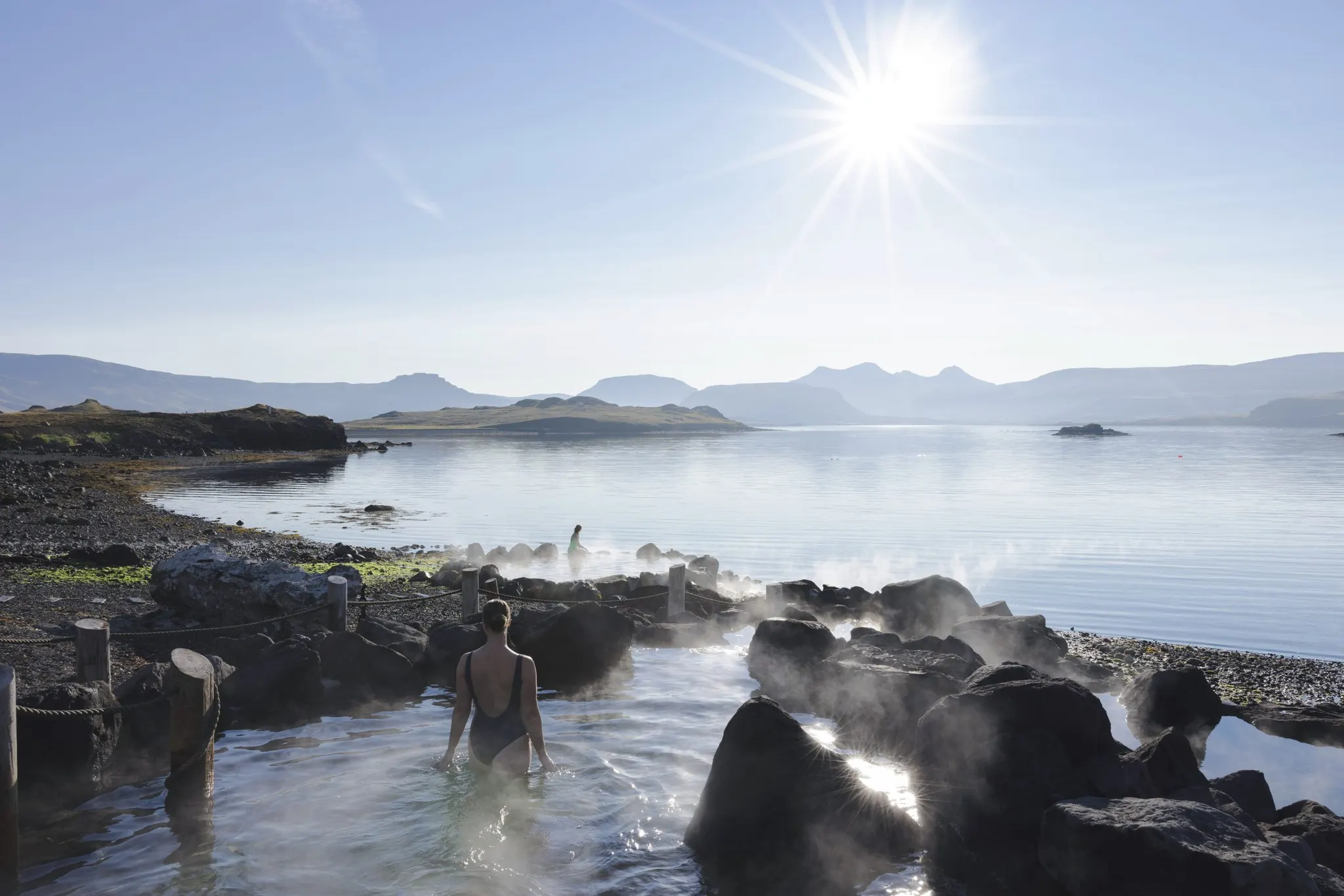
Hvalfjörður
Hvammsvík Hot Springs
Eight hot springs on the shore, rising and falling with the tide
70 km away as the raven flies